This Hidden Corner of Brunei Will Blow Your Mind—Here’s Why
Nestled deep in the rainforest, Temburong, Brunei’s isolated district, feels like a secret the world hasn’t cracked yet. I went expecting quiet villages and jungle trails—but was stunned by architectural gems blending tradition and nature. From floating mosques to stilted longhouses, each landmark tells a story. This isn’t just travel; it’s discovery in its purest form. Far from the glitz of capital cities, Temburong offers a rare glimpse into how people live in harmony with their environment. Its buildings do not dominate the landscape—they belong to it. Here, architecture is not about spectacle but balance, not about permanence but adaptation. This is a place where culture, climate, and craftsmanship converge in quiet brilliance.
Discovering Temburong: Brunei’s Best-Kept Secret
Temburong stands apart—literally and figuratively—from the rest of Brunei. Located over sixty kilometers southeast of Bandar Seri Begawan and separated by Malaysian territory, this secluded district can only be reached by boat or a scenic ferry ride across the Brunei Bay. This geographical isolation has preserved its lush rainforests, pristine rivers, and traditional ways of life in a way few places in Southeast Asia still can. While much of the region has modernized rapidly, Temburong remains refreshingly untouched, a sanctuary where nature sets the pace and human activity follows its rhythm.
The district spans over 1,300 square kilometers, most of which is protected rainforest. It is home to fewer than 10,000 residents, many of whom live in small riverside communities connected by wooden jetties and narrow footpaths. Because of limited road access and strict conservation policies, development has remained low-impact. This deliberate restraint has allowed Temburong to retain its ecological integrity and cultural authenticity. Unlike mass-tourism hotspots, there are no sprawling resorts or neon-lit streets—just quiet villages where children wave from canoes and elders sit beneath shaded verandas.
Yet, Temburong’s remoteness is not a limitation—it is its strength. The lack of infrastructure has become an asset, shielding the region from unchecked urbanization. Travelers who make the journey are rewarded not with convenience, but with depth. Here, every structure, from the smallest fishing hut to the most prominent mosque, reflects a deep respect for place. The architecture does not shout; it whispers. It does not imitate global trends; it listens to the land. In a world increasingly defined by speed and scale, Temburong offers a counter-narrative—one of slowness, care, and continuity.
What makes Temburong truly special is how its built environment mirrors its values. The people here have not rejected modernity, but they have chosen to integrate it thoughtfully. Solar panels appear on rooftops, and mobile phones are common, yet these modern tools coexist with ancestral practices. The longhouse remains a home, not a museum exhibit. The mosque rises not as a monument, but as a living part of daily life. This balance—between progress and preservation—is not accidental. It is the result of deliberate choices made across generations, choices that are now visible in the very walls, roofs, and walkways of the district.
The Iconic Sultan Haji Omar Ali Saifuddien Mosque: A Modern Marvel in the Jungle
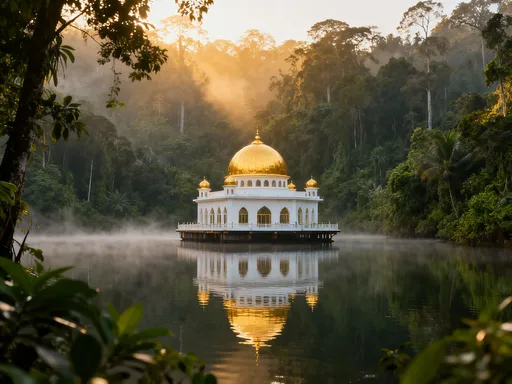
Standing like a golden crown amid the green canopy, the Sultan Haji Omar Ali Saifuddien Mosque is one of Temburong’s most striking landmarks. Its gleaming golden dome and slender minaret rise above the treetops, catching the morning light in a way that feels almost sacred. Built to serve the spiritual needs of the local Muslim community, the mosque is also a bold architectural statement—a symbol of faith, identity, and national pride in a region far from the country’s political center. Its presence reminds visitors that even in remote areas, culture and religion are not diminished, but deepened.
The design of the mosque blends classical Islamic architecture with practical adaptations for the tropical climate. The large central dome is flanked by smaller domes and arched windows that promote natural ventilation, reducing the need for artificial cooling. The minaret, standing over thirty meters tall, is both elegant and functional, serving as a visual anchor and a call to prayer. The prayer hall, capable of accommodating hundreds, features cool marble floors, intricate geometric tile work, and hand-carved wooden screens that filter sunlight into delicate patterns. Every element—from the calligraphy on the walls to the orientation toward Mecca—reflects deep reverence and intentionality.
What sets this mosque apart is not just its beauty, but its context. Unlike urban mosques that blend into city skylines, this one stands in deliberate contrast to its surroundings. Yet, it does not dominate the landscape. Instead, it complements it. The reflective pool in front mirrors the dome and sky, creating a sense of serenity. The surrounding gardens are planted with native species, attracting birds and butterflies. Even the materials used in construction were selected for durability in high humidity and heavy rainfall. This thoughtful integration shows how architecture can honor both tradition and environment.
For visitors, the mosque offers more than aesthetic awe—it invites reflection. Standing before its grand entrance, one cannot help but feel a sense of humility. The quiet hum of cicadas, the rustle of palm fronds, and the distant call to prayer create a sensory experience that is both grounding and uplifting. This is not a place built for tourists, but for community. Yet, those who visit are welcomed with warmth and respect. The mosque stands as a testament to the idea that sacred spaces can be both majestic and humble, modern and timeless, local and universal.
Traditional Longhouses: Living Heritage on Stilts
In the heart of Temburong’s villages, the longhouse remains the cornerstone of communal life. These elevated wooden structures, built on sturdy stilts, stretch along riverbanks like quiet sentinels of tradition. Constructed primarily from belian hardwood—one of the most durable timbers in the world—and topped with attap palm-thatched roofs, longhouses are designed to withstand floods, humidity, and the test of time. Each house is not just a shelter but a living archive of Orang Ulu culture, where generations share space, stories, and responsibilities under one expansive roof.
The layout of a longhouse follows a clear social logic. A central corridor runs the length of the building, connecting individual family units that open onto it. Each family has its own enclosed room, but the corridor serves as a shared living space—used for cooking, weaving, storytelling, and receiving guests. At one end, there is often a communal area for ceremonies, meetings, or school lessons. The elevated design protects against flooding and allows for airflow beneath, keeping the interior cool. Ladders or wooden staircases lead up from the riverbank or forest floor, reinforcing the house’s connection to both land and water.
What makes these longhouses remarkable is their authenticity. Unlike reconstructed versions seen in tourist villages, the ones in Temburong are fully inhabited and actively maintained. Modern amenities such as electricity, solar lighting, and mobile internet are present, but they are woven into the traditional framework without disrupting its essence. A grandmother may cook over a wood fire while her granddaughter studies on a tablet nearby. This quiet coexistence of old and new speaks to the resilience of the culture—one that evolves without erasing its roots.
Living in a longhouse fosters a unique sense of interdependence. Decisions are often made collectively, disputes are resolved through dialogue, and celebrations are shared. The architecture itself encourages this—there are no closed doors, no private yards, no isolation. This communal ethos is not enforced; it is built into the space. For travelers, a visit to a longhouse is not just a cultural tour, but a lesson in harmony. It challenges the modern notion that privacy and progress must come at the expense of community. In Temburong, the longhouse proves that belonging can be both physical and profound.
The Kuala Belalong Field Studies Centre: Science Meets Architecture
Deep within the Ulu Temburong National Park lies the Kuala Belalong Field Studies Centre—a modest yet vital hub for scientific research and environmental education. Operated in collaboration with local and international universities, the center serves as a base for biologists, ecologists, and conservationists studying one of the oldest rainforests in the world. What makes it remarkable is not its size, but its design philosophy: every structure is built to minimize impact while maximizing function. Elevated walkways, thatched roofs, and open-air laboratories blend seamlessly into the jungle, creating a space where science and nature coexist in balance.
The center’s buildings are raised on stilts to avoid disturbing the forest floor and to allow wildlife to move freely underneath. Walls are made of woven bamboo or treated wood, allowing for cross-ventilation and reducing the need for air conditioning. Roofs are steeply pitched to handle heavy rainfall, and gutters direct water into collection tanks for reuse. Solar panels provide power, and composting toilets reduce waste. These features are not luxury add-ons—they are essential components of a system designed for sustainability in a remote location with no grid access.
From an architectural standpoint, the center exemplifies form following function. The walkways connect dormitories, labs, and dining areas without requiring clearing of vegetation. Observation decks are positioned to offer views of the canopy and river without disturbing nesting birds or feeding primates. Even the lighting is designed to be low-impact, using warm, motion-sensitive LEDs that do not disrupt nocturnal animals. Every decision reflects a deep understanding of the ecosystem and a commitment to non-intrusion.
For visiting researchers and students, the center offers more than shelter—it offers immersion. Sleeping in a cabin surrounded by the sounds of frogs, insects, and distant gibbons is a reminder of how small humans are in the web of life. The architecture does not isolate; it connects. It does not shield completely; it exposes. This deliberate openness fosters a sense of responsibility and wonder. The Kuala Belalong Centre is not just a place to study nature—it is a model of how to live within it, respectfully and intelligently.
The Ulu Temburong National Park Canopy Walkway: Engineering in the Treetops
One of the most unforgettable experiences in Temburong is walking the canopy walkway in Ulu Temburong National Park. Suspended fifty meters above the forest floor, this series of steel and wooden bridges connects towering dipterocarp trees, offering a bird’s-eye view of one of the most biodiverse ecosystems on Earth. The walkway is not just an attraction—it is a feat of engineering designed to provide access without destruction. Built with corrosion-resistant materials and anchored to living trees using flexible brackets, it moves slightly with the wind, mimicking the natural sway of the canopy.
Reaching the walkway requires a boat ride, a jungle trek, and a climb up a series of ladders and suspension bridges. The journey itself is part of the experience, gradually shifting one’s perspective from ground level to the treetops. As visitors ascend, the sounds change—the rustle of leaves replaces the crunch of soil, the calls of hornbills and kingfishers replace the chatter of ground birds. Light filters through in dappled patterns, and the air grows cooler and fresher. At the highest point, the forest unfolds in every direction, a sea of green stretching to the horizon.
Safety is carefully managed without compromising the sense of adventure. The walkway is equipped with secure railings, weight limits, and regular inspections. Guides ensure that groups are small and movements are slow, minimizing disturbance to wildlife. The structure is designed to last for decades but can be dismantled with minimal trace if needed—a principle of reversibility that underscores the park’s conservation ethic.
What makes the canopy walkway transformative is not just the view, but the shift in awareness it creates. From above, the forest is no longer a collection of trees, but a complex, interconnected system. Epiphytes cling to branches, vines form aerial highways, and insects pollinate flowers unseen from below. This vertical dimension of life, often ignored, becomes vividly real. The walkway does not exploit nature for spectacle; it reveals what was already there. It is a rare example of tourism infrastructure that enhances understanding rather than diminishing it.
Community Centers and Public Buildings: Simplicity with Purpose
Beyond the iconic mosques and research stations, Temburong’s everyday architecture tells its own story. Community halls, village schools, and health clinics may lack grandeur, but they are vital to the social fabric. These buildings are typically single-story, built with local wood and metal roofs, and designed for functionality over form. Yet, within their simplicity lies intention. Wide eaves provide shade, open windows encourage airflow, and raised floors protect against dampness. These are not just practical choices—they are cultural ones, rooted in generations of living in harmony with the tropics.
In many villages, the community hall serves as a multipurpose space—hosting weddings, funerals, religious classes, and town meetings. Its large, open interior can be reconfigured as needed, reflecting the flexibility valued in communal life. The school, often the largest building in a village, is more than a place of learning—it is a symbol of hope and continuity. Children study under ceiling fans powered by solar energy, using textbooks that include local history and environmental science. Teachers often live on-site, reinforcing the bond between education and community.
What stands out is the absence of architectural pretense. There are no attempts to impress or imitate foreign styles. These buildings do not seek attention; they serve. Their understated presence contrasts sharply with the flashy developments seen in other parts of the region. Yet, in their quiet reliability, they embody a deeper truth: that good design is not about aesthetics alone, but about meeting real needs with dignity and care. In Temburong, public architecture is not a status symbol—it is a service.
For visitors, these spaces offer a chance to witness daily life without intrusion. A morning at the village school, a conversation at the clinic, or a shared meal in the community hall provides insight into a way of life that values connection over convenience. The buildings themselves become silent teachers, showing how modesty, sustainability, and community can coexist in a world often obsessed with scale and speed.
Why Temburong’s Architecture Matters: A Reflection on Place and Identity
Temburong’s buildings are more than structures—they are expressions of identity. Each one, from the golden dome of the mosque to the thatched roof of a longhouse, reflects a people who understand their place in the world. They do not seek to conquer nature, but to collaborate with it. They do not build for fame, but for function. In a global era where architecture often serves capital or spectacle, Temburong offers a quiet alternative: one rooted in resilience, adaptation, and cultural pride.
The architectural choices here are not accidental. They are the result of centuries of observation, trial, and wisdom. Building on stilts is not just practical—it is a response to floods and wildlife. Using belian hardwood is not just traditional—it is a choice of durability in a humid climate. Designing open spaces is not just aesthetic—it fosters community in a society that values collective well-being. Every decision is layered with meaning, shaped by both environment and heritage.
Moreover, Temburong’s architecture embodies environmental awareness long before it became a global trend. There are no glass towers blocking sunlight, no concrete jungles replacing forests. Instead, there is a deep respect for balance—between human needs and ecological limits, between modern tools and ancestral knowledge. This is sustainable living not as a marketing slogan, but as a lived reality.
For travelers, Temburong offers a rare opportunity: to see a place where architecture does not erase culture, but reveals it. It invites us to rethink what we value in design—not just beauty or innovation, but belonging, responsibility, and continuity. In a world increasingly disconnected from place, Temburong reminds us that buildings can be rooted, not rootless. They can be quiet, not loud. They can serve, not dominate.
This hidden corner of Brunei does not shout for attention. It does not need to. Its power lies in its stillness, its integrity, its quiet confidence. To visit Temburong is not just to see a new destination, but to experience a different way of being. It challenges us to slow down, to listen, to observe. And in doing so, it offers not just sights, but insight. For those willing to make the journey, the reward is not just discovery—but transformation.